During my sixteen hours of driving this weekend I listened to episode 466 of Ear Biscuits which discussed atheist spirituality. I am not an atheist, but I thought the discussion on their Christian deconstruction and the ensuing struggles fascinating.
Within this episode some points stood out in relation to student affairs practice:
For many, the idea of secular spiritual development may seem contradictory. Taking the vast definition of spirituality (past just religion) and the inherent restrictions of public student affairs work (that is, practicing within the 1st amendment), I think there is an intentionally open working definition. Staying secular, I believe student affairs professionals can focus on developing spiritual experiences for students, which is often overlooked in practice. It should be said this is not about rejecting religion - it is about creating beneficial experiences and development for all.
If a student is asked if they are spiritual, it is more and more likely they will say no. This may be from being raised in a non-religious household, not seeing one's life actions as having spiritual value, or even just word choice. Spirituality to some may be seen as believing in the supernatural, which is not necessarily the case.
Whether we need to promote new activities to promote spiritual experiences or reframe existing experiences to fit within this lens, I found the Tree of Contemplative Practices to be a potential tool.
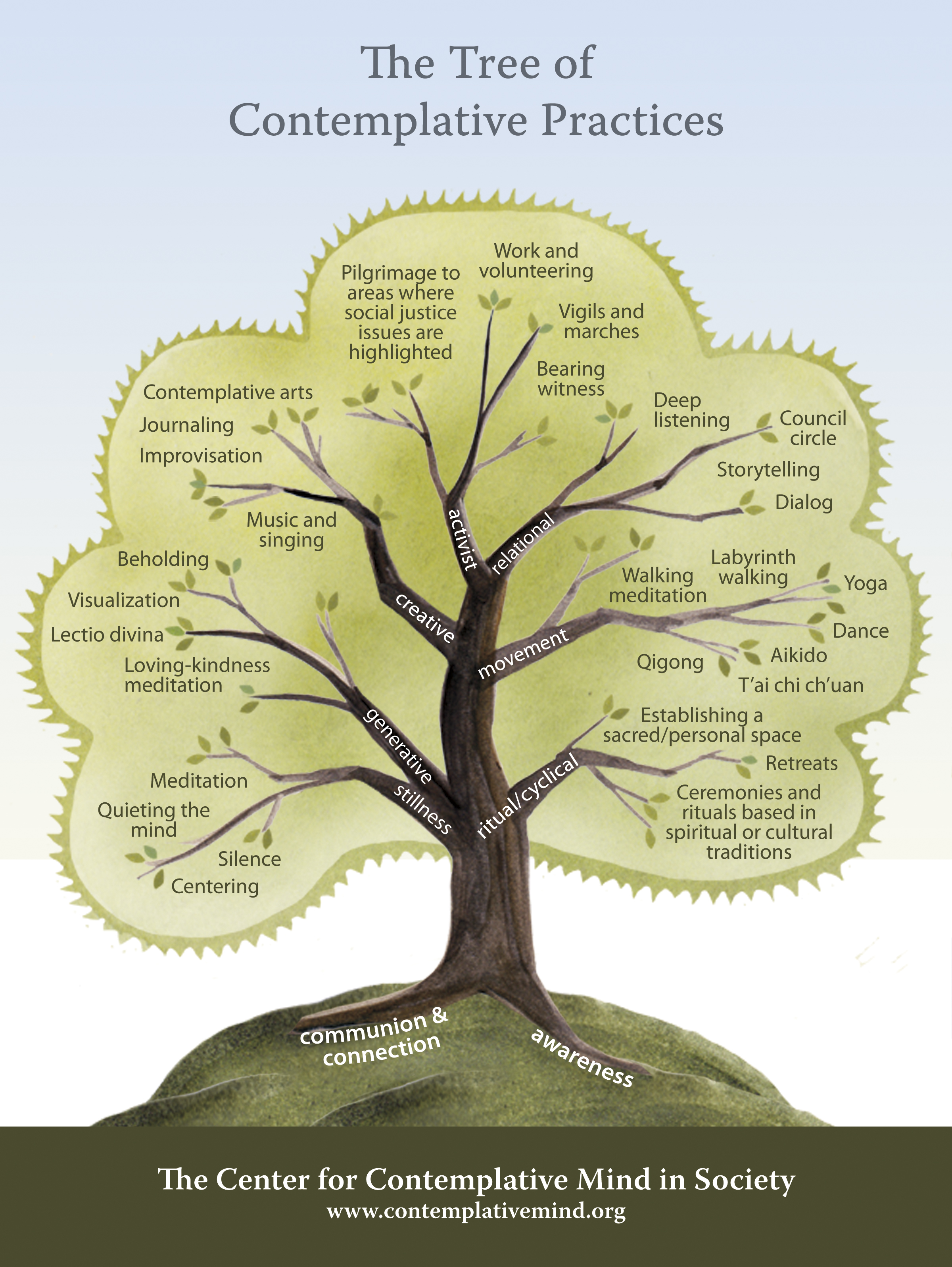
Tree of Contemplative Practices. Click on image for full version.
With the roots of the tree representing awareness cultivation and connection to the divine or inner wisdom and the branches different groupings of practices, I think this is an excellent graphic to use with students. Show this to a student, ask them if any of the practices resonate or are important to them. From what is identified, ask them to focus on how they feel when they do that activity. The emotions, the feelings, the experience, the significance. That is what we are after.
One story from the podcast episode was that many Christian mothers do not see themselves as spiritual. While their husbands may go off on spiritual retreats and advance through their church, they are left at home to care for the children. In fact, caring for others is truly a life of service and is absolutely spiritual. How do we enable people to see the spiritual significance of their work?
Looking at the tree for myself, meditation, labyrinth walking, rituals, music, retreats, dialogue, beholding, and retreats are all practices in which I have had spiritual experiences. These things drive connection to the world, to their creator (if an individual believes in such), to the self. They can be full-body physical and emotional experience. In sum - one feels alive.
I've only had a day to chew on this, but I hope it brought some thoughts to you. As always, I'm down to chat via email below.
 Brendan Trachsel © Copyright 2025